
What are F-Gases Used for in Commercial Refrigeration?
F-Gases, short for fluorinated gases, are refrigerants commonly used in commercial refrigeration systems such as fridges, freezers and cold rooms. They play a critical role in keeping food and drink businesses running safely, but they also have a significant environmental impact if not managed correctly.
Because of this impact, the use and handling of F-Gases is tightly regulated in the UK. Even though most food businesses never come into direct contact with these gases, they are still affected by the rules governing how refrigeration equipment is installed, maintained, and inspected.
Understanding what F-Gases are and why they are considered harmful helps explain why professional refrigeration maintenance and compliance matter in the first place.
What are F-Gases?
F-Gases, or fluorinated gases, are a group of man-made gases commonly used as refrigerants in commercial cooling equipment. In food and drink settings, they’re most often found inside refrigeration systems such as upright fridges, freezers, cold rooms and blast chillers.
These gases circulate within a sealed system, absorbing heat from inside the cabinet and releasing it outside. This process is what allows refrigeration equipment to maintain stable, food-safe temperatures throughout the day.
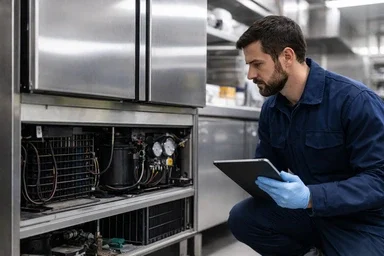
Although F-Gases are essential for modern refrigeration, they are not something most business owners ever see or handle directly. They remain contained within the system and are only accessed during installation, servicing, repairs or decommissioning by qualified engineers.
Because F-Gases are so widely used across commercial refrigeration, they are a key focus of environmental regulation - not due to how often they’re used, but because of the impact they can have if released into the atmosphere.
Why Are F-Gases Harmful?
F-Gases are considered harmful because they have a very high global warming potential when released into the atmosphere. In simple terms, even small amounts can contribute significantly more to climate change than carbon dioxide.
Under normal conditions, F-Gases remain sealed inside refrigeration systems and pose no direct risk. Problems arise when gases escape due to leaks, poor maintenance, or improper handling during repairs or disposal.
Unlike some other emissions, F-Gases do not break down quickly once released. This means their environmental impact can last for many years, which is why governments around the world have taken steps to tightly control how they are used and managed.
The goal of regulation is not to eliminate refrigeration, which is essential for food safety, but to reduce unnecessary emissions through proper system design, regular inspections, and responsible maintenance by qualified professionals.
Why this matters for food & drink businesses
Refrigeration is unavoidable for food and drink businesses. From preserving ingredients to meeting food safety standards, reliable cooling is a fundamental part of daily operations.
While most businesses never handle F-Gases directly, they are still responsible for the equipment that contains them. This means ensuring refrigeration systems are properly maintained, inspected when required, and serviced by qualified professionals.
Poorly maintained equipment is more likely to develop leaks, operate inefficiently, or fail unexpectedly, all of which can increase environmental impact and cause costly disruption to your business.
Understanding the role F-Gases play in refrigeration helps explain why regular maintenance and professional oversight are so important. It’s not about managing gases yourself, but about ensuring the systems you rely on are looked after correctly.
Businesses operating refrigeration systems should ensure compliance is managed professionally and in line with UK F-Gas requirements.
Why F-Gases are tightly regulated in the UK
Because F-Gases are tightly regulated in the UK, businesses operating commercial refrigeration systems must ensure compliance is handled correctly. Learn more about our F-Gas compliance services for commercial refrigeration.
For food and drink businesses, this doesn’t mean learning the regulations in detail or managing refrigerants directly. Instead, it means understanding why professional maintenance matters and why refrigeration work must be carried out by properly qualified engineers.
If you’d like to learn more about what this means in practice — including inspections, maintenance and compliance responsibilities — our guide to using an F-Gas registered engineer explains the next steps in more detail.